
Are all your vaccinators appropriately trained, up to date and assessed as competent for the vaccines they deliver?
The UKHSA National Minimum Standards and Core Curriculum for Vaccination Training, updated in June 2025, provide a single framework for healthcare staff involved in vaccination. This includes registered healthcare professionals (RHPs) and healthcare support workers (HCSWs).
For employers and vaccination leads, it’s a useful opportunity to review your team’s training records and ask: does everyone have the right training for their role?
At a glance: your vaccination training checklist
| Staff / role | Foundation training | Annual update | BLS & anaphylaxis | Cold chain | Competency assessment | Programme-specific training |
| Practice Nurse – new to vaccination | ✓ | ✓ | ✓ | ✓ | ✓ | ✓ |
| Experienced Practice Nurse / Immuniser | Evidence of previous training | ✓ | ✓ | ✓ | ✓ | ✓ |
| Pharmacist – new vaccinator | ✓ | ✓ | ✓ | ✓ | ✓ | ✓ |
| Experienced Pharmacist Vaccinator | Evidence of previous training | ✓ | ✓ | ✓ | ✓ | ✓ |
| HCSW / HCA – new vaccinator | ✓ Appropriate to role | ✓ | ✓ | ✓ | ✓ | ✓ Within agreed scope |
| Experienced HCSW / HCA | Evidence of previous training | ✓ | ✓ | ✓ | ✓ | ✓ |
| Nursing Associate | ✓ | ✓ | ✓ | ✓ | ✓ | ✓ |
| Paramedic Vaccinator | ✓ | ✓ | ✓ | ✓ | ✓ | ✓ |
| Staff delivering childhood immunisations | ✓ | ✓ | ✓ | ✓ | ✓ | ✓ Childhood programme |
| Staff delivering adult programmes only | ✓ Appropriate to role | ✓ | ✓ | ✓ | ✓ | ✓ Relevant programmes |
| Travel Health Practitioner | ✓ | ✓ | ✓ | ✓ | ✓ | ✓ Additional travel health training |
| Staff returning after a significant break | Training needs assessment | ✓ | ✓ | ✓ | ✓ Before independent practice | ✓ |
Training requirements should always be considered in relation to the individual’s professional role, previous training and experience, local governance arrangements and the vaccines/programmes they deliver.
New to vaccination? Start with foundation training
Vaccinators who are new to immunisation/vaccination should undertake comprehensive foundation training appropriate to their role and covering the relevant UKHSA core curriculum.
Training should include areas such as:
- the immune system and how vaccines work
- vaccine-preventable diseases
- the UK vaccination schedule
- vaccine indications, contraindications and precautions
- consent and communication
- vaccine safety
- legal aspects of vaccination
- vaccine storage and the cold chain
- vaccine administration
- recognition and management of adverse reactions, including anaphylaxis
- documentation and record keeping
- professional responsibilities and limitations.
Foundation training can be tailored to the individual’s role. Someone delivering a limited range of vaccines may have different training needs from a practitioner responsible for the full childhood and adult vaccination programmes.
Already an experienced vaccinator?
Completing foundation training isn’t the end of the training journey.
Experienced vaccinators need to keep their knowledge and skills current through regular immunisation updates – recommended to be annual updates at a minimum.
Updates should reflect changes to national programmes, eligibility, schedules, vaccine recommendations, Green Book guidance, vaccine products, safety information and relevant legal or governance arrangements.
And remember: experience in one vaccination programme doesn’t automatically mean competence in another.
For example, an experienced adult flu vaccinator moving into childhood immunisation will require appropriate childhood programme-specific training and competency assessment.
Don’t forget programme-specific training
Whenever a member of staff takes on a new vaccination programme, consider whether additional training is needed.
This might include:
Childhood immunisation – the routine schedule, catch-up vaccination, consent and age-specific considerations.
Seasonal influenza – current eligibility, vaccine selection, administration and annual programme changes.
Adult programmes – including shingles, pneumococcal and RSV vaccination.
Vaccination in pregnancy – including pertussis, RSV and influenza.
Travel vaccination – additional travel health education and training appropriate to the practitioner’s role.
A simple question for vaccination leads is:
“Is this person trained and competent for the vaccines and population they are actually working with?”
Training certificate ≠ competency
This is an important distinction.
Completing a vaccination course does not, by itself, demonstrate that someone is competent to vaccinate independently.
New vaccinators need appropriate practical experience, supervision and support, with their competence assessed before independent practice.
The UKHSA Vaccinator Competency Assessment Tool provides a structured framework for assessing vaccinators and should be used alongside the National Minimum Standards.
Competence should also be reviewed as appropriate, particularly when a vaccinator’s role changes or they begin delivering a new programme.
What about HCSWs and HCAs?
The previous standalone National Minimum Standards for Healthcare Support Workers, published in 2015, have been withdrawn.
Since June 2025, registered practitioners and HCSWs are covered by the same overarching UKHSA vaccination training standards.
However, this doesn’t mean that HCSWs can automatically deliver every vaccination programme.
Their training and competency must be appropriate to their defined role and scope of practice, with clear governance, delegation, supervision and support arrangements in place.
HCSWs must understand the limitations of their role, when they need to seek advice and when a decision must be referred to an appropriately registered healthcare professional.
Time for a training audit?
Take a look at your vaccination team and check that you can evidence:
✓ Appropriate foundation training
✓ Regular vaccination updates
✓ Programme-specific training
✓ BLS and anaphylaxis training
✓ Cold chain and vaccine storage training
✓ Competency assessment and sign-off
✓ Appropriate supervision and support
✓ Training relevant to the vaccines each individual actually delivers
Most importantly, don’t just ask:
“Have they completed a vaccination course?”
Ask:
“Are they appropriately trained, up to date and competent for the vaccination role they are undertaking?”
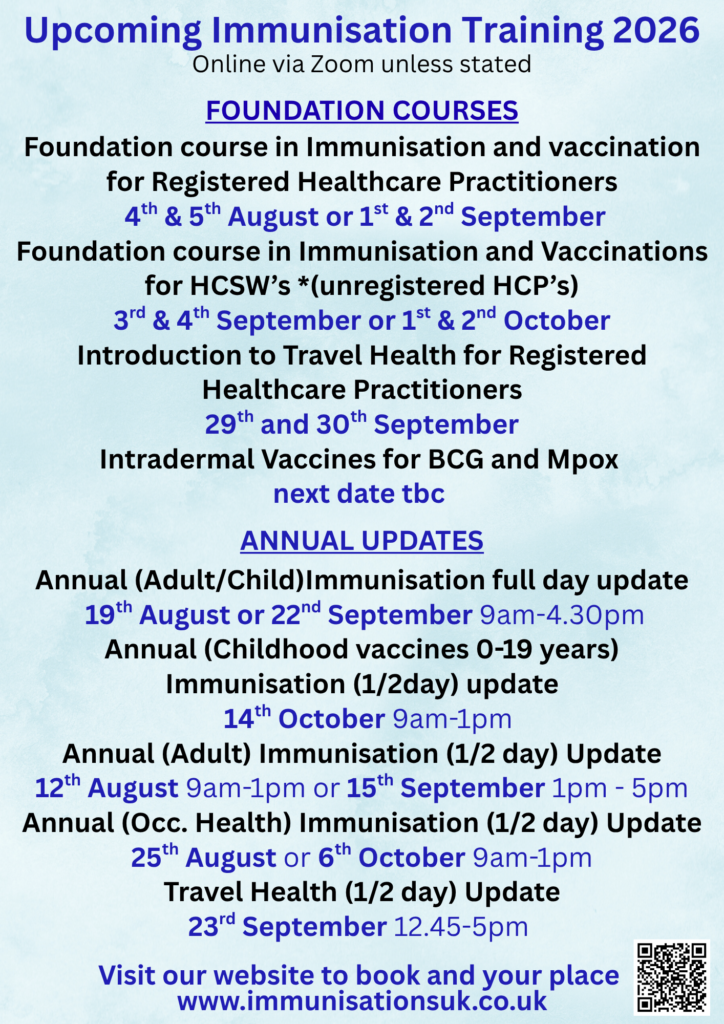
Need to update your team’s vaccination training?
Immunisations UK Ltd provides interactive and engaging Immunisation and Travel Health training for healthcare professionals, delivered by experienced Immunisation and Travel Health Specialist Nurses.
Whether you have staff who are new to vaccination, experienced vaccinators needing an update, or HCSWs developing their vaccination role, ensuring training remains current is an important part of safe and effective vaccination practice.
Useful UKHSA resources
National Minimum Standards and Core Curriculum for Vaccination Training
GOV.UK – National minimum standards and core curriculum for vaccination training
Vaccinator Competency Assessment Tool
Available alongside the UKHSA National Minimum Standards on GOV.UK.