
In today’s rapidly evolving public health landscape, immunisation remains one of the most powerful tools we have to prevent disease, protect communities and improve life expectancy. To support those on the frontline of vaccination delivery, the UK Health Security Agency (UKHSA) has published updated Quality Criteria for an Effective Immunisation Programme. This guidance sets out the essential elements required to implement and deliver immunisation services that are safe, equitable and of consistently high quality.
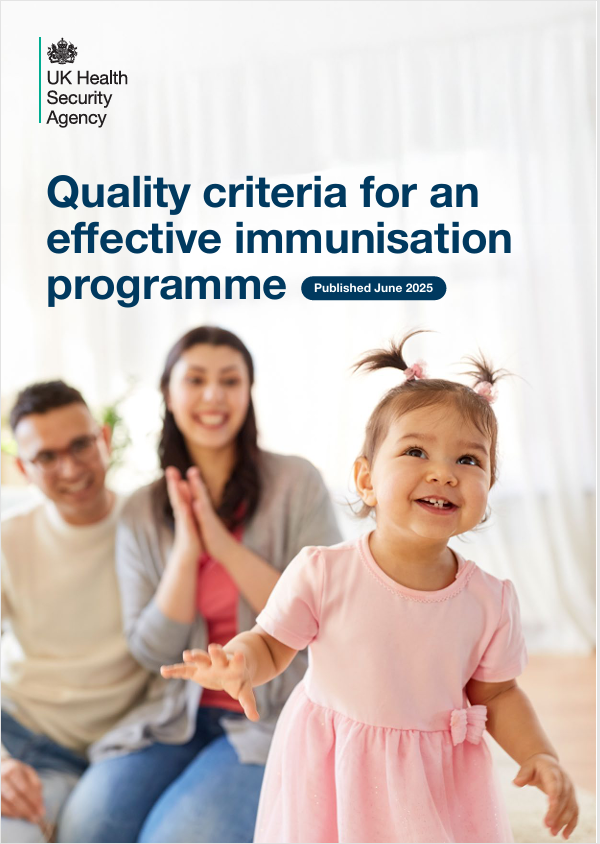
Whether you work in primary care, community health, secondary care, pharmacies or outreach clinics, these criteria are relevant to your daily practice and provide a clear framework for improving vaccination services for all. (UKHSA 2025)
Why Quality Matters in Immunisation
The success of the UK’s immunisation programmes depends not only on the vaccines themselves, but also on the systems and services that deliver them. High-quality immunisation services help:
- maximise vaccine uptake and population coverage
- protect individuals and communities from vaccine-preventable diseases
- reduce inequalities in access and health outcomes
- maintain public confidence in vaccines and immunisation services
(UKHSA 2025)
Core quality criteria that every service should strive for
The UKHSA guidance outlines several interconnected areas that together define what “quality” means in immunisation delivery. These are intended to be applied across all settings where vaccines are delivered.
1. Unequivocal Focus on Equity
Equity isn’t a standalone task, it’s an overarching commitment. Services must actively identify and address barriers that prevent certain individuals or groups from accessing immunisation. This includes tackling geographic, socio-economic or cultural challenges that contribute to unequal uptake (UKHSA 2025).
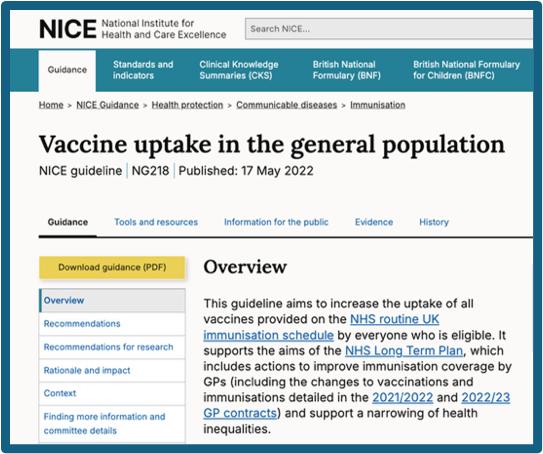
The NICE guidelines Vaccine Uptake in the general population published May 2022 aims to increase uptake of all vaccines provided on the NHS routine UK immunisation schedule. It includes actions to improve immunisation coverage by GP’s and support a narrowing of health inequalities.
2. Accessible and Inclusive Services
Vaccines should be offered in ways that make access as easy as possible for all eligible people:
- use convenient locations and times
- proactively reach out to underserved populations
- design services that recognise differing needs across life stages and communities.

3. Clear, Effective Communication
Communication with patients is central to quality immunisation:

- share accurate, easy-to-understand information about vaccines and their benefits
- tailor messages to diverse audiences and address misinformation
- ensure consent discussions are robust and culturally appropriate.
4. Comprehensive Assessment Before Vaccination
Safety starts with proper assessment:
- check eligibility and immunisation history
- consider clinical risk factors and contraindications
- use standardised tools to guide decision-making.
5. Safe Transport, Storage and Handling
Ensuring vaccines are:
- stored at correct temperatures
- transported securely
- handled to maintain potency and reduce waste
… is a fundamental part of quality assurance.

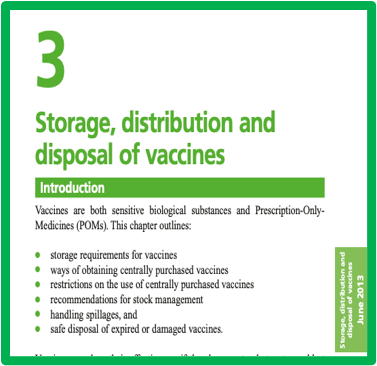
Practitioners are responsible for ensuring that best practice is followed for ordering, storing, distributing and disposing of vaccines, in all settings; see the Green Book chapter 3 for the full guidance that should be followed.
6. Accurate Documentation and Record Keeping
Good records are the backbone of immunisation quality:
- record all vaccine administration details in a timely manner
- ensure data is complete, legible and compliant with legal and clinical standards
- use records to support recall and reminder systems
7. Vigilant Reporting of Adverse Events and Incidents
A high-quality programme has robust systems for:
- reporting vaccine incidents or adverse events
- analysing trends and learning from errors
- feeding back improvements into practice quickly
Healthcare professionals should report suspected vaccine reactions in accordance with the appropriate regulatory guidance by reporting to the Medicines and Healthcare Products Regulatory Agency (MHRA) via the Yellow Card Scheme, even if they are uncertain as to whether the vaccine caused the adverse reaction.

Healthcare professionals should report suspected vaccine reactions in accordance with the appropriate regulatory guidance by reporting to the Medicines and Healthcare Products Regulatory Agency (MHRA) via the Yellow Card Scheme, even if they are uncertain as to whether the vaccine caused the adverse reaction.
8. Competent and Supported Staff
Immunisation quality depends on people:
- staff should receive comprehensive initial training and regular updates
- training should cover clinical practice, vaccine policy and communication skills
- supervision and support should be continuous to build confidence and competence

At Immunisations UK Ltd, practitioners can access high quality immunisation courses delivered in line with the UKHSA National Minimum Standards and Core Curriculum for Vaccination Training 2025.
9. Strong Coordination Across the System
Immunisation doesn’t happen in a vacuum. It’s delivered through a network of teams and organisations. Effective coordination means:
- clear roles and responsibilities across services
- seamless communication between primary care, public health, commissioners and others
- integrated systems that support smooth patient journeys
Putting the Criteria into Practice
As frontline healthcare staff, you can use these criteria as a practical checklist to reflect on your local service.
Think about:
- Are there groups in your population that are missing out?
- Have staff received up-to-date training aligned with national standards?
- Are communication methods tailored to diverse needs?
- Do your documentation and reporting processes support good practice and improvement?
Embedding quality into every interaction helps protect individuals and strengthens trust in vaccination – both critical to achieving high uptake UKHSA 2025.
Key Points: A Handy Summary
- Equity first – design and deliver services that reach everyone, especially underserved groups
- Access matters – make vaccine services easy to use, timely and responsive
- Communicate clearly – provide accurate, understandable information and address misconceptions
- Assess safely – check eligibility and clinical history before vaccination.
- Handle vaccines correctly – maintain cold chain and storage standards
- Document thoroughly – keep accurate, compliant records
- Report and learn – use incident reporting to improve quality
- Train and support staff – invest in competence and confidence
- Coordinate well – align efforts across teams and organisations
By centring quality in every part of immunisation delivery, we safeguard individuals, strengthen communities and uphold the integrity of the programme. Keep these criteria at the heart of your practice – they are more than standards; they are a roadmap to excellence in immunisation care.
USEFUL RESOURCES

Childhood vaccines: parental attitudes survey 2025 findings UKHSA 2025
Tailoring Immunization programmes WHO 2019
General practice vaccination and immunisation services: standards and core contractual requirements