
Chickenpox put 3,037 children and young people in England into hospital in 2025, the last year before varicella vaccination joined the routine NHS schedule. That figure comes from the UK Health Security Agency’s Varicella Annual Report 2025, published on 30 October 2026 alongside a call for parents to make sure their children are protected.
For those of us delivering childhood immunisations, the report is a useful reminder of why MMRV matters. It also lands just as the catch-up programme for older children got under way on 1 November 2026, so many practices will be fielding questions from families right now.
What the 2025 data shows
The youngest children carried most of the burden. Under-5s accounted for over 70% of clinical chickenpox reports to UKHSA Health Protection Teams, and the hospitalisation rate in babies under 1 was more than double that in 1 to 4 year olds.
| Measure (England, 2025, under-18s) | Figure |
| Hospital admissions for chickenpox | 3,037 |
| GP consultations (sample of about a third of practices) | Over 15,000 |
| Share of clinical reports in children aged 5 and under | Over 70% |
| Hospitalisation rate, under 1 year | 5.8 per 100,000 |
| Hospitalisation rate, 1 to 4 years | 2.3 per 100,000 |
| Absences recorded in 439 sampled nurseries and primary schools | 4,117 |
These numbers understate the true picture. Most chickenpox is managed at home without any contact with health services, so it never reaches surveillance data.
As UKHSA Consultant Epidemiologist Dr Gavin Dabrera put it, the figures show chickenpox is not just a mild illness, particularly for very young children.
The routine MMRV schedule
Since 1 January 2026, MMRV has replaced MMR in the routine childhood programme. Children get 2 doses, at 12 months and 18 months, alongside their other routine vaccines. Bringing the second dose forward from 3 years 4 months means more children are fully protected before they start school.
Babies under 12 months are not routinely offered MMRV, as their immune response may not be strong enough. They rely on vaccinated older children to reduce the circulation of the virus.
Because the change was phased in by date of birth, the schedule a child follows depends on when they were born:
| Date of birth | What they are offered |
| 1 January 2025 or later | MMRV at 12 months and 18 months |
| 1 July to 31 December 2024 | MMR at 12 months (before the change), then MMRV at 18 months and 3 years 4 months |
| 1 September 2022 to 30 June 2024 | MMR at 12 months, then a single MMRV at 3 years 4 months |
| 1 January 2020 to 31 August 2022 | Selective single-dose MMRV catch-up, 1 November 2026 to 31 March 2028 |
| 31 December 2019 or earlier | Not eligible for MMRV; offer MMR if not fully vaccinated |
Full eligibility by date of birth is set out in Table 1 of the UKHSA guidance for healthcare practitioners (linked below).
The catch-up programme and children behind schedule
From 1 November 2026 to 31 March 2028, children born between 1 January 2020 and 31 August 2022 are being offered a single catch-up dose of MMRV. These children have already had two MMR doses, so the catch-up adds varicella protection.
- It is for children who have not had chickenpox or two doses of varicella vaccine.
- Practices do not need to check chickenpox history for children who come forward.
- Children born on or before 31 December 2019 are not eligible for MMRV and should be offered MMR if they need it.
Since the start of the MMRV programme in January 2026, UKHSA has published a webpage for healthcare practitioners to support those delivering the childhood MMRV programme. It describes eligibility, administration and safety, and answers frequently asked questions about the programme, including what to offer a child who is behind schedule.
Please refer to Table 2 on that page.
In summary, Table 2 sets out:
| Age now | No previous MMR | One previous MMR, no MMRV |
| 1 year to 18 months | MMRV now, second at 18 months (at least 4 weeks after the first) | Depends on date of birth: MMRV at 18 months and 3 years 4 months (born Jul–Dec 2024), or MMRV now and at 18 months (born 2025 onwards) |
| 18 months to under 3 years 4 months | MMRV now; second at 3 years 4 months (born Sep 2022–Jun 2024) or 4 weeks later (born Jul 2024 onwards) | MMRV as the second MMR-containing dose; timing and whether a further MMRV follows depend on date of birth |
| 3 years 4 months to under 6 years | MMRV now, second 4 weeks later; no recall needed for the catch-up | MMRV as the second MMR-containing dose; those born Jan 2020–Aug 2022 stay eligible for the catch-up dose |
| 6 years and older | Born 2019 or earlier: 2 MMR, 4 weeks apart. Born 2020 onwards: 2 MMRV, 4 weeks apart | Born 2019 or earlier: second MMR. Born Jan 2020–Jun 2024: one MMRV |
This is a simplified summary. Always check the full table before deciding what to give.
A few general rules also apply:
- Children born from 1 January 2020 who are behind should be caught up with MMRV rather than MMR.
- Any dose given before the first birthday is discounted and repeated.
- Doses should be at least 4 weeks apart.
Practical points for vaccinators
The practitioner guidance covers these in detail; the points below are the ones most likely to come up in clinic.
Vaccines: Two products are used: ProQuad (MSD), which contains porcine gelatine, and Priorix-Tetra (GSK), which does not. They are interchangeable, so the two doses do not need to be the same brand. Offer Priorix-Tetra to families who object to porcine gelatine.
Contraindications: Do not give MMRV to children who are severely immunosuppressed, or who have had confirmed anaphylaxis to a previous measles, mumps, rubella or varicella vaccine or to a component such as neomycin. Postpone if a child is acutely unwell with a fever; a minor illness such as a cold is not a reason to delay. Previous chickenpox, egg allergy and a family history of febrile convulsions are NOT contraindications.
Post-vaccination rashes: A measles-like rash may appear around a week after vaccination and lasts 2 to 3 days. A varicella-like rash, usually at the injection site, can appear within a month; it should be covered but does not mean exclusion from nursery or school. A widespread rash away from the injection site is rare, may be natural chickenpox, and should be seen by a GP.
Fever and febrile convulsions: Fever is common in the 2 weeks after vaccination. After the first dose, the risk of a febrile convulsion is about 1 in 1,000 doses, usually 5 to 10 days later. That is higher than with separate MMR and varicella vaccines, but far lower than the risk from measles itself, which is about 1 in 43 cases. Prophylactic paracetamol is not needed. Avoid ibuprofen if a varicella-like rash appears 3 to 4 weeks after vaccination; use paracetamol for fever instead.
Co-administration: MMRV can be given at the same time as, or at any interval from, other childhood vaccines, including live ones. The exception is yellow fever vaccine.
Report suspected adverse reactions through the Yellow Card scheme.
When parents decline MMRV
Some parents are refusing MMRV and asking for MMR instead. To support practitioners, UKHSA circulated the following guidance in February 2026:
In these cases, the healthcare professionals should find out why the parents or carers are requesting MMR vaccine rather than MMRV vaccine and should discuss their concerns fully.
If after explanations and reassurance has been given, parents still decline the MMRV vaccine, leaving the child vulnerable to infections such as measles, healthcare professionals may use their clinical discretion and offer MMR vaccine under a Patient Specific Direction (PSD). It should be noted that this should not be considered the norm, or that choice is being offered in the routine childhood immunisation schedule. It is pragmatic advice in the small number of instances where parents still decline MMRV after appropriate advice has been given, and the clinician is concerned that the child remains vulnerable to other infections.
Where MMR is offered, centrally procured stock of MMR vaccine can be used.
In practice, the conversation often comes down to a few common concerns:
- “Chickenpox is mild.” For most children it is, but 3,037 children were admitted to hospital with it in England in 2025, and babies under 1, too young to be vaccinated, had a hospitalisation rate more than double that of 1 to 4 year olds.
- “Isn’t it better to catch it?” Natural infection can cause serious complications, and the virus stays in the body and can reactivate as shingles later in life.
- Gelatine. Priorix-Tetra contains no porcine gelatine, which may resolve the objection.
- Febrile convulsions. The small increase after the first dose is real and worth explaining honestly, alongside the much greater risk from measles itself.
Resources for parents and clinicians
Leaflets, posters and other materials can be viewed, downloaded or ordered free of charge from Find Public Health Resources. Search by title or product code, or contact the team on 0300 123 1002 (Monday to Friday, 9am to 5:30pm) or publichealthresources@ukhsa.gov.uk.
| Resource | Audience | Product code |
| MMRV vaccination: a guide for parents and carers (give with appointment invitations) | Parents | 9791EN002 |
| Easy read guide to the MMRV vaccination | Parents | 1386405EEN001 |
| Is your child eligible for an MMRV? (catch-up leaflet) | Parents of children born 1 Jan 2020 – 31 Aug 2022 | See catch-up resources page |
| MMRV vaccine poster | Waiting rooms, community settings | 9797EN001 |
| MMRV catch-up poster | Waiting rooms, community settings | 979AEN001 |
| A guide to vaccination at 18 months | Parents | 1265469BEN001 |
| MMRV single dose selective catch-up resources | Clinicians and stakeholders promoting the catch-up | – |
| MMRV vaccination: information for healthcare professionals (eligibility tables, FAQs) | Clinicians | Online only |
| Annexe A: information and resources to support implementation | Clinicians and commissioners | Online only |
For children not eligible for MMRV, the MMR for all leaflet has been revised for that group.
Making every contact count
The catch-up runs until 31 March 2028, but every chickenpox season that passes leaves more young children exposed. Check eligibility whenever a child aged 4 to 6 is seen, follow up families who have not responded to invitations, and use Table 2 for any child who is behind. As Public Health Minister Dame Diana Johnson said, every eligible family should be encouraged to make sure their child gets the MMRV vaccine.
Sources
- UKHSA: New report shows toll of chickenpox with over 3,000 infants hospitalised last year (30 October 2026)
- UKHSA: Epidemiology of varicella (chickenpox) in England, 2025
- UKHSA: MMRV vaccination: information for healthcare professionals (Tables 1 and 2)
- UKHSA guidance on parents declining MMRV, circulated February 2026 via locality Screening and Immunisation Teams Bulletins.
Staff Training
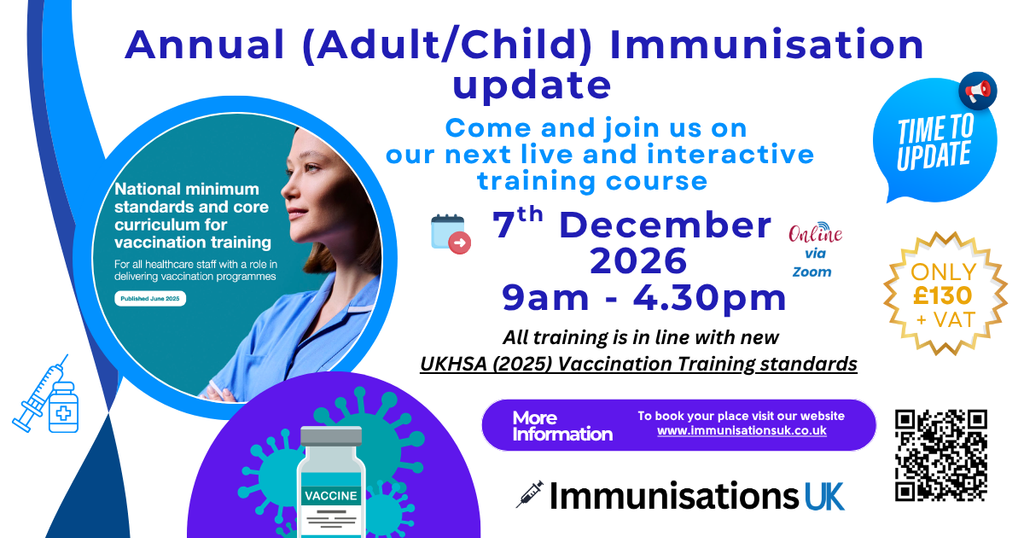
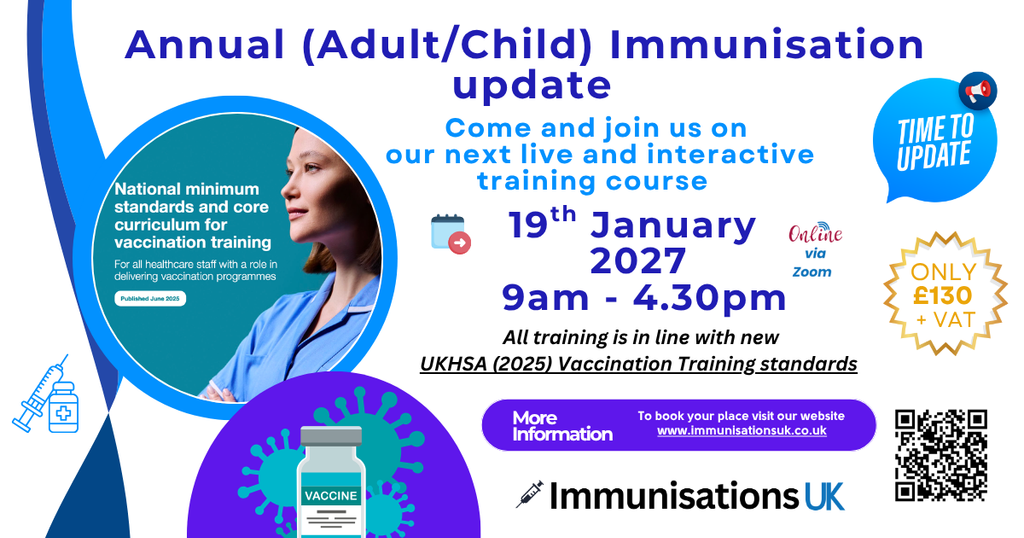
Ensure all staff delivering and advising on vaccines are appropriately trained in line with UKHSA (2025) National Minimum Standards and Core Curriculum for Vaccination Training – GOV.UK and signed off as competent using this national tool Appendix A Vaccinator competency assessment tool workbook.
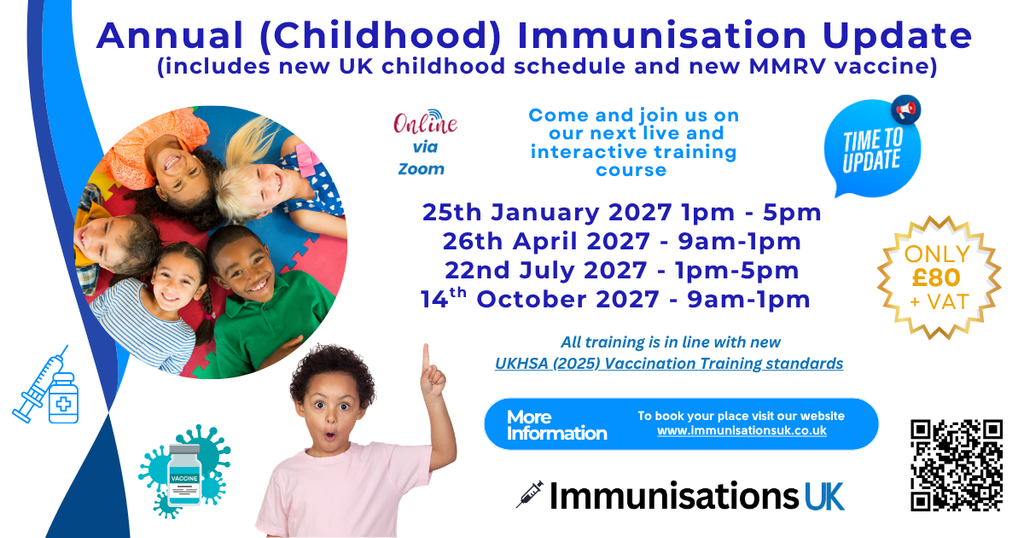
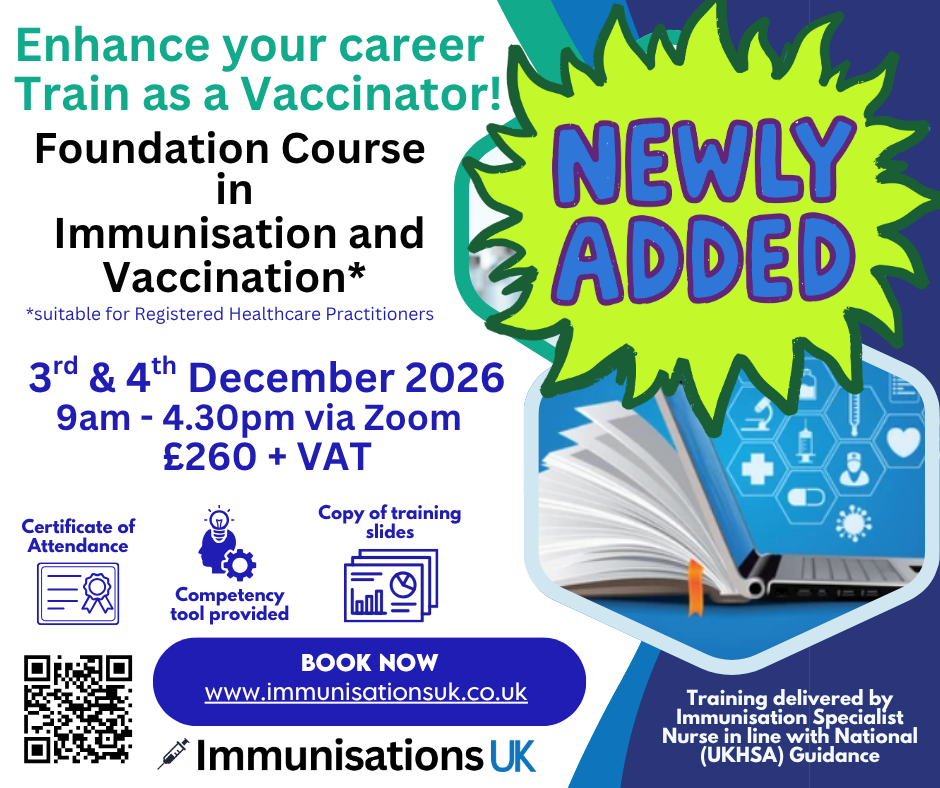
At Immunisations UK Ltd, all training is delivered by an Immunisation Specialist Nurse and in line with UKHSA (2025) training standards. See below for training courses offered, or browse the Company brochure on the home page.
Thanks for reading my article. If you want to learn more ⬇️
🔗 Connect to follow Me
📅 Check out our training dates 2026/2027